
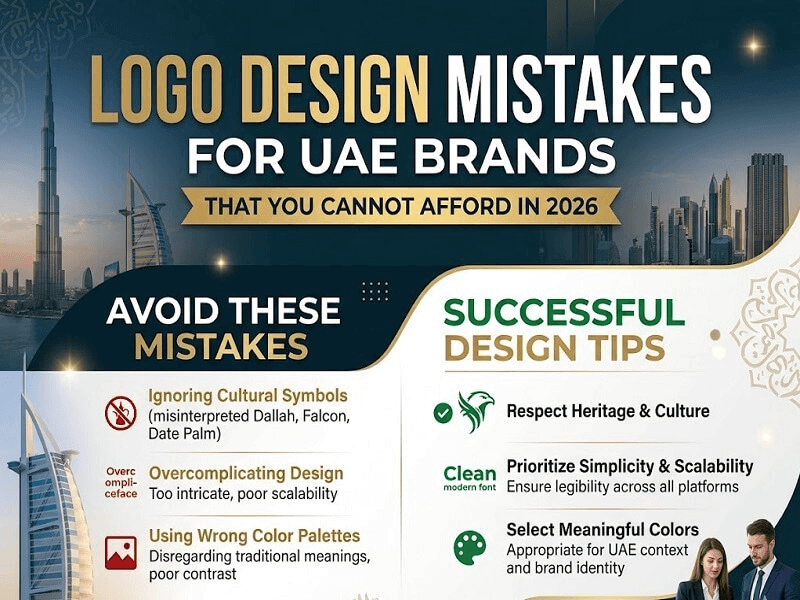
Logo Design Mistakes for UAE Brands That You Cannot Afford in 2026
One of the most interesting trends observed in the UAE market is design awareness among local individuals. Walk through any mall in Dubai or even scroll the internet, and you will find a huge range of brands everywhere.
Do you know what makes them stand out from others? Well, it is their ability to present themselves and be distinguished in this crowded workforce.
In 2026, consumers have developed a sharp eye for credible and authentic sources, and here, logo and design play a significant role in gaining that trust. If you are still assuming that a logo is nothing more than a symbol, you cannot possibly enter the industry with this mindset.
Let’s find out how you can build your presence in a way that resonates with modern audiences and gives your reputation a standout touch.
Why Is Logo Design Important?
The UAE is not a typical single-market environment; instead, it is a meeting place of cultures, demands, and international standards. The people here are comparing local brands with international giants daily. This approach showcases that your visual identity is not only competing on a local scale, but it is also being compared on an international level as well. A logo in this setting should accomplish three things immediately,
- Communicate credibility
- Reflect cultural awareness
- Signal premium value even for mid-range brands
If your brand fails in any of these areas, your visual representation does not feel like itself. In a market where trust is currency, this is certainly an expensive error.
What Is the Real Effect of a Bad Logo on Brand Trust?
It is quite essential to know what will actually be at stake before making any blunders in your logo design Dubai. A weak logo immediately makes customers hesitate, and they start questioning authenticity, and they eventually, or you can say unconsciously, correlate bad design with bad service.
In the UAE, in particular, where luxury and professionalism are deeply embedded in consumer expectations, a substandard logo can decrease the perceived value of products or services. It could lead to scepticism regarding brand authenticity, it also lowers conversion rates on digital platforms and harms long-term brand recall and loyalty.
What Are Some Noticeable Mistakes, and How Can One Avoid Them
- Are You Choosing Trends Over Trust?
The problem is that many businesses are pursuing what is in trend, instead of meaningful. Minimalistic typefaces, minimalist icons, or heavily gradient designs might appear current, but they are actually hollow and do not hold any value.
In the UAE, where audiences appreciate both innovation and cultural depth, trend-chasing creates a shallow identity, and the customers are aware that it is a temporary thing.
The Solution
Do not rely on trends and bring something that will still be in your credit for the coming five years. You can also ask the professionals as well and define to them what your brand is about, and the emotional response you are interested in. They help in bringing an effective strategy that goes beyond trends and helps customers move towards your brand with trust.
- Is Your Logo Culturally Aligned?
There are far more logos in the UAE that do not take into consideration cultural nuance. Colours, symbols, and typography may not always meet the expectations of a region or may not appeal to the local audiences.
As an example, what was an effective design in Europe will seem out of place or even offensive in the Gulf environment.
The Solution
Cultural fit does not imply that one should be traditional, but rather be conscious. What you have to consider here is,
- Emotional meaning of colours in the Middle East context
- The equilibrium between modernity and heritage
- The subtle cues that signal respect and authenticity
The firms that manage to brand UAE markets do not copy international aesthetics, but they smartly borrow them and adapt them to suit their regions.
- Are You Overcomplicating Your Visual Identity?
Some logos are designed in a way that communicates too much. A design might be enriched by multiple elements, intricate details, and layer upon layer of symbolism, but in the end, it turns confusing. In a high-paced setting such as Dubai, the attention span is short, and when a logo takes some work to decode what it tells, it is already not working.
The Solution
Always remember that clarity builds trust. A good logo must be instantly recognisable, replicable across platforms with ease, and memorable without explanation.
- Do You Only Design for Print or Not for Screens?
Another common mistake when you are doing branding UAE is that many logos are still created with conventional formats in mind, such as brochures, business cards, and signage. However, the majority of interactions in 2026 take place on screens.
When a logo appears fantastic on paper but becomes unclear on mobile devices, it generates inconsistency, which diminishes trust.
The Solution
You should design with a digital-first approach. Your logo should easily scale between devices and maintain clarity at small sizes, such as app icons. Make sure to adjust to various formats and backgrounds, and test it not just where you want it to appear good, but where your audience will see it.
- Does your logo seem generic?
Similarity is perceived as something negative in a competitive environment like the UAE. Globes, abstract swooshes, and generic initials are examples of overused symbols in logos that blend into the background. Customers won’t remember you, and trust won’t develop if they can’t visually identify your brand.
The Solution
Being distinctive is more about being specific than it is about being loud. What you have to do is pay attention to,
- What distinguishes your brand?
- How to visualise that difference
When you make a distinctive visual signature that your competitors cannot match, your logo starts providing the impression that it is exclusive to your brand.
FAQs
How can I tell whether my brand is being harmed by my logo?
Your logo may be a contributing factor if, despite having good offerings, your brand has trouble being recognised, trusted, or consistent. What analytics fail to show often comes out in customer perception.
Should I improve my logo or entirely rework it?
It actually depends on how serious the problem is. While bigger issues could necessitate a complete redesign, minor misalignments can be corrected by refinement.
How often should a logo be changed?
Reviewing it every three to five years guarantees that it remains current without losing brand equity. But there is no set schedule for it.
Can a logo establish trust on its own?
Not by itself, but it lays the groundwork. The logo usually helps in building the first impression, and initial impressions influence everything that comes after.
Conclusion
Thinking that you will know when the logo needs a fresh glow-up can be a mistake. The design does not fail loudly, but it is actually done very quietly when you miss opportunities. But, at the same time, these mistakes are flexible and can be solved when you start with the right perspective. And, this is exactly where your logo starts shifting from being just a symbol to becoming the sole identity of your brand.

Amira Al Hadi is a senior creative strategist at LogoDesigner.ae with a deep passion for visual identity and modern brand storytelling. She loves to work with startups, SMEs, and established businesses across the UAE, she understands how powerful design can shape perception and drive growth. From minimalist logos to complete brand identity systems, Amira combines cultural awareness with global design trends to craft meaningful visuals.
In her articles, she shares practical guidance on logo psychology, color theory, typography choices, and rebranding strategies tailored for the fast-paced UAE market. Her goal is simple: to help business owners understand the “why” behind great design so they can build brands that look professional, memorable, and future-ready.